
The dressing change
Some wounds do not
arrive in rectangles.
Heavy exudate, recurring slough, maceration at the margins. The wound bed never gets stable enough to progress to the next step in the plan of care, and the patient keeps coming back to the same visit.
Adherence often makes it worse. A dressing that binds to granulating tissue takes some of that tissue with it at every change, disturbing the wound bed your team is trying to stabilize.
So the question is not only what a dressing absorbs. It is what it costs you to take it off, in a clinic that sees every kind of wound, not just one.
Wound Care: Request XLTA Samples
Assess XLTA® on the wounds you are managing now. No cost, no commitment.
We reply within two business days.
What changes on the unit
Three things XLTA® is built to do differently.
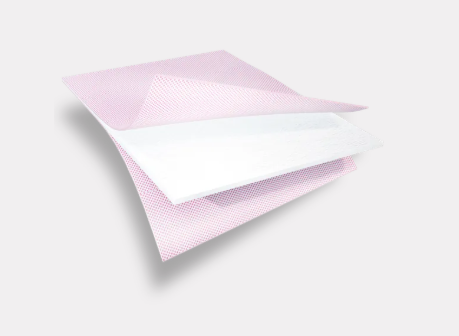
It comes away without taking the wound bed with it
Non-adherent layers on both faces, so orientation does not matter and neither side binds to granulating tissue.
One range covers the full exudate load
Three weights and seven sizes, trimmed to the wound and layered where drainage is heaviest.
It works mechanically, with nothing added
Unmedicated, predominantly natural fiber. No active ingredient to reconcile against grafts or systemic therapy.
Mechanism
Why the wound bed stays intact.
Exudate is drawn up out of the wound, spread in every direction through the fiber network, and held there. A physical process, not a chemical one.
Hydrocapillary flow
Draws exudate up and away from the wound surface, so fluid is not sitting against tissue.
Omnidirectional dispersion
Spreads it in every direction through the fiber matrix, up, across and through, instead of pooling at the point of uptake.
Electrostatic sequestration
Charged fibers attract and hold bacteria, cytokines and MMPs inside the dressing.
In practice
Shaped to the wound, not the box.
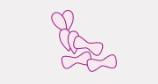
Cut with scissors to match the anatomy in front of you, including a facial mask for facial wounds, secured with a fishnet bandage.
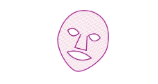
Facial mask
Facial wounds
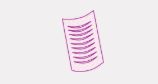
Joint shapes
Elbows and knees
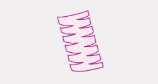
Zig zag
Limbs and curves
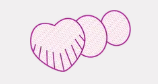
XHeart, oval
Cavities, amputations
Teardrop
Between digits
Application
- Clean. Saline or an appropriate solution, aseptic technique.
- Apply. Cut to the wound and extend roughly two inches beyond the periwound. Either face down. Layer for heavy exudate.
- Cover. Any standard secondary dressing. The burn cohort used Melolin with a conforming bandage.
- Redress. Driven by saturation. Moisten before removal if the dressing has dried.
Formats
Every weight comes in 2″, 3″, 4″, 6×8″ and 8×8″ sheets, plus 4×39″ and 8×39″ rolls.
- Trim to fit
- Primary or secondary
- Layerable
- Daily to 3-day wear
- Unmedicated
Published results are a reason to look. Your own wounds are the reason to decide.
Request samples