The stalled wound
When a wound stalls, the clock on salvaging the limb starts running.
Every week a wound sits in the inflammatory phase is a week the reconstructive window narrows. Non viable slough holds it there, and the plan of care cannot advance to grafting until the wound bed is clean and granulating.
A dressing that adheres to the wound works against you. Every. Time. A dressing that binds to granulating tissue takes some of that tissue with it at every change, resetting progress you cannot afford to lose twice.
So the question is not only what a dressing absorbs. It is how quickly it gets you a wound bed you can graft.
CNF | Samples Request
Assess XLTA® on the wounds you are managing now. No cost, no commitment.
We reply within two business days.
What changes on the service
Three things XLTA® is built to do differently.
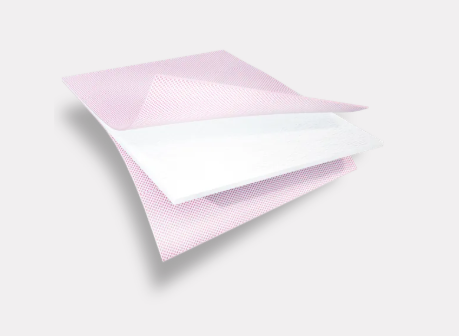
It does not undo the wound bed you just built
Non-adherent layers on both faces, so neither side binds to granulating tissue and progress is not reset at every change.
It works under compression, as applied in the case
Applied directly to the wound surface beneath a non stretch Kerlix and Ace wrap, with no change to the underlying care plan.
Nothing to reconcile against what comes next
Unmedicated and mechanical, with no active ingredient to weigh against grafts, skin substitutes or systemic therapy.
Mechanism
Why the wound bed stays intact.
Exudate is drawn up out of the wound, moved sideways through the fibre network, and held there. A physical process, not a chemical one.
Hydrocapillary flow
Draws exudate up and away from the wound surface, so fluid is not sitting against tissue.
Horizontal dispersion
Spreads it laterally through the fibre matrix instead of pooling at the point of uptake.
Electrostatic sequestration
Charged fibres attract and hold bacteria, cytokines and MMPs inside the dressing.
The case
Extensive slough to graft ready, in 23 days.
An 81 year old patient presented with a ruptured hematoma of the right lower extremity. Non healing, non progressing, with extensive non viable slough. Comorbidities included congestive heart failure, type II diabetes, obesity and edema. The team needed a wound bed stable enough to receive a dermal skin graft substitute.
The wound progressed without a change in the underlying care plan. Anthony Colonna, DPM · James Lin, DO · George M. Munro, LPN. LECOM Health, Institute for Successful Living. De-identified retrospective case; informed consent and image release on file. Single case; individual results vary.
In practice
Shaped to the limb, not the box.
Cut with scissors to match the anatomy in front of you, including spiral and zig zag shapes for limbs and curved surfaces, and cavity shapes for amputation sites.

Facial mask
Facial wounds
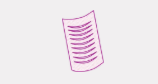
Joint shapes
Elbows and knees
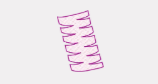
Zig zag
Limbs and curves
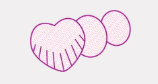
XHeart, oval
Cavities, amputations
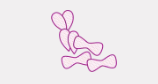
Teardrop
Between digits
Application
- Clean. Saline or an appropriate solution, aseptic technique.
- Apply. Cut to the wound and extend roughly two inches beyond the periwound. Either face down. Layer for heavy exudate.
- Cover. Any standard secondary dressing. The burn cohort used Melolin with a conforming bandage.
- Redress. Driven by saturation. Moisten before removal if the dressing has dried.
Formats
Every weight comes in 2″, 3″, 4″, 6×8″ and 8×8″ sheets, plus 4×39″ and 8×39″ rolls.
- Trim to fit
- Primary or secondary
- Layerable
- Daily to 3-day wear
- Unmedicated
One published case is a reason to look. Your own limbs are the reason to decide.
Request samples