Between visits
In the home, the dressing is on its own.
In a facility, a saturated dressing gets changed. In the home, it waits. Your nurse sees the patient twice a week, and whatever is on the wound has to cover the other five days without supervision.
When it saturates early the options are all poor: an unscheduled visit, a family member attempting a change they were never trained for, or a dressing left in place far longer than it should be.
So the question is not only what a dressing absorbs. It is whether it still holds on day three, and whether it comes away without taking fragile skin with it.
Home health | Samples Request
Assess XLTA® on the wounds you are managing now. No cost, no commitment.
We reply within two business days.
What changes in the field
Three things XLTA® is built to do differently.
It holds between visits
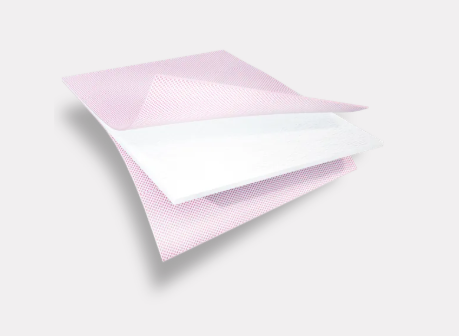
Handles up to nine times its own weight in fluid, with hydrocapillary flow moving exudate away from the wound bed instead of letting it pool at the surface.
It comes away without tearing fragile skin
Non-adherent layers on both faces, so orientation does not matter and removal stays atraumatic even after three days in place.
One line covers the whole caseload
Three weights and seven sizes, trimmed to any wound shape, so nurses carry one product in the bag rather than three.
Mechanism
Why the wound bed stays intact.
Exudate is drawn up out of the wound, moved sideways through the fibre network, and held there. A physical process, not a chemical one.
Hydrocapillary flow
Draws exudate up and away from the wound surface, so fluid is not sitting against tissue.
Horizontal dispersion
Spreads it laterally through the fibre matrix instead of pooling at the point of uptake.
Electrostatic sequestration
Charged fibres attract and hold bacteria, cytokines and MMPs inside the dressing.
The visit gap
Two visits a week. Five days on its own.
A typical home health schedule puts a nurse in front of the patient twice a week. Every other day, whatever is on the wound has to hold without supervision. That is the requirement a home health dressing is actually being asked to meet.
Wear time is set by saturation, wound condition and provider direction, not by the calendar. The schedule above is a common pattern, not a claim about any individual patient.
In practice
Shaped to the wound, not the box.
Cut with scissors in the home to match the anatomy in front of you, including cavity shapes for sacral and heel wounds and teardrop shapes between toes.

Facial mask
Facial wounds

Joint shapes
Elbows and knees
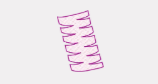
Zig zag
Limbs and curves
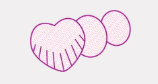
XHeart, oval
Cavities, amputations
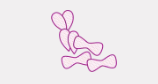
Teardrop
Between digits
Application
- Clean. Saline or an appropriate solution, aseptic technique.
- Apply. Cut to the wound and extend roughly two inches beyond the periwound. Either face down. Layer for heavy exudate.
- Cover. Any standard secondary dressing. The burn cohort used Melolin with a conforming bandage.
- Redress. Driven by saturation. Moisten before removal if the dressing has dried.
Formats
Every weight comes in 2″, 3″, 4″, 6×8″ and 8×8″ sheets, plus 4×39″ and 8×39″ rolls.
- Trim to fit
- Primary or secondary
- Layerable
- Daily to 3-day wear
- Unmedicated
Published results are a reason to look. Your own patients are the reason to decide.
Request samples